Kyrie Cunctipotens Genitor Deus
I composed this Kyrie for the third edition of the international sacred-music composition competition Premio “Francesco Siciliani” (2016), and dedicated it to the Fondazione Perugia Musica Classica. It is built on the ancient chant Cunctipotens Genitor Deus, one of the most elaborate of the Gregorian Kyries, whose melody is printed in full at the head of the score. Every note of my setting grows from that chant: each of the three sections takes its melody from the corresponding chant section.
The writing is horizontal in conception, as my chant-based music tends to be: the counterpoint comes first, and the harmony arises from the movement of the lines. Each movement follows the same general plan. The chant is first intoned plainly in unison quarter-notes. Then the same melody, broadened into half-notes, becomes a cantus firmus around which the other voices weave their counterpoint. The mode is Dorian throughout, taken from the chant itself: the first Kyrie in D Dorian, the Christe a fourth higher in G Dorian, the final Kyrie returning to D Dorian.
The first Kyrie, marked molto espressivo e legatissimo, unfolds in three statements of the text. The cantus firmus begins in the tenors and passes to the basses while imitative counterpoint surrounds it. The second statement opens as a fughetta, the basses singing the subject and each higher voice following, with running eighth-notes decorating the lines for the first time. The third statement, implorante, gathers all voices into a homophonic plea, an upward-sweeping melisma cresting at different moments in each part. The music calms to a bare open fifth on D at the last syllable. .
A half-bar of silence prepares the Christe, the solemn center of the work. Transposed up a fourth to G Dorian, it opens with the chant intoned by altos and tenors in unison, two timbres fused into one. The character is contrito, contrite, more subdued and inward than the pleading Kyries that frame it. The counterpoint moves quietly around the altos’ cantus firmus before they hand it to the tenors and join the texture, swelling once to a forte at the close of the first statement, then sinking to an open fifth on G. The second statement is a soft fughetta whose subjects are drawn from the chant: the basses announce the theme and the tenors answer it inverted, the altos and then the sopranos following in turn. Here, flattened notes darken the mode toward a true G minor, as a further darkening cadences in C minor. The final statement, con umiltà, is humility itself, piano and sotto voce. Every voice is low in its range, without swell or emphasis of any kind; the ensemble finally settles on a hushed open fifth on G.
The final Kyrie returns to D Dorian, but its chant is more elaborate than the first, and so is its treatment. After an intonation in the sopranos and altos, the music grows more active, eighth-notes animating the counterpoint. At its center stands the most ambitious passage of the work: a double fugue. I divided the chant into two subjects: the “Kyrie” melody, poco marcato, and the “eleison” melody in long augmentation, legatissimo. I set the two themes against each other, exchanging them among the voices through stretto and inversion as the texture builds. The counterpoint rises at last to a high, sustained climax over a pedal point on A. The sopranos crest near the top of their range before a chain of suspensions draws the voices back into homophony for the final statement.
The ending is quiet and reverent. After two movements of modal austerity, each closing on an open fifth, the final Kyrie comes to rest for the first time on a full chord, A major, the third entering softly and low in the tenor voice, the dynamic fading from mp to pp. It is not a triumphant arrival but a gentle one, containing the hope of mercy. The divided basses murmur one final “eleison” as the upper voices sustain their chord, and the prayer comes to rest.
The audio clips offer two windows into the work. The first is the opening of the first Kyrie; the second begins partway through the final Kyrie, after the intonation and before the double fugue. The full text is the ninefold Kyrie of the Mass:
|
Kyrie eleison. Christe eleison. Kyrie eleison. |
Lord, have mercy. Christ, have mercy. Lord, have mercy. |
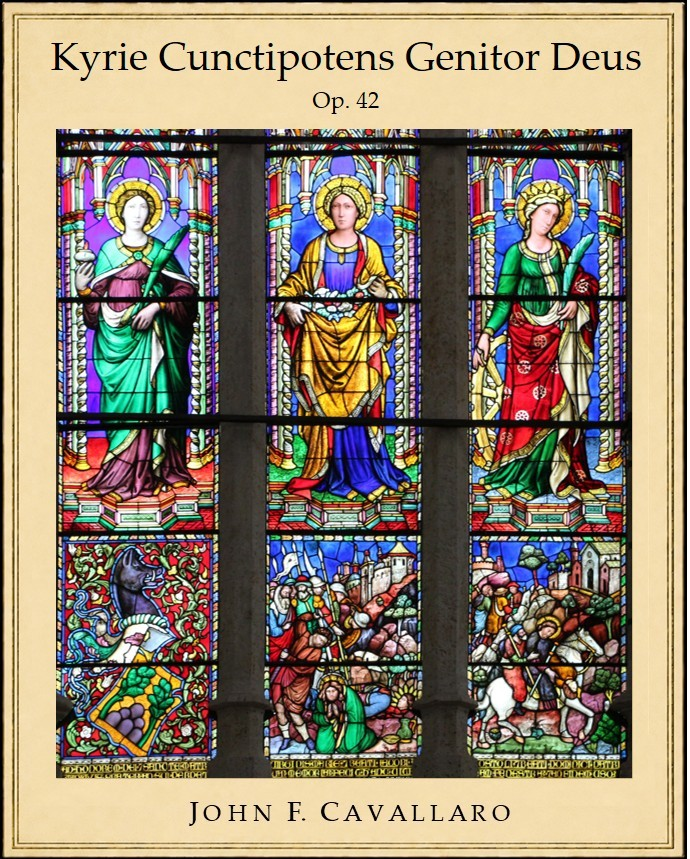
Photo credit: The apse window in the Cathedral of San Domenico, Perugia Italy. Di Sailko – Opera propria, CC BY 3.0, https://commons.wikimedia.org/w/index.php?curid=56572348
Opus 42 | SATB a cappella | Latin | 8:00
Licensed as a single-use PDF download
Up to 20 copies: $4.50/copy
Unlimited choral license: $90.00
PREVIEW
Customers Also Bought
Related products
-
Add to WishlistAdd to Wishlist
Salve Regina
$4.50 – $90.00Price range: $4.50 through $90.00 Select options This product has multiple variants. The options may be chosen on the product page -
Add to WishlistAdd to Wishlist
-
Add to WishlistAdd to Wishlist
Levate in Excelsum
$3.50 – $70.00Price range: $3.50 through $70.00 Select options This product has multiple variants. The options may be chosen on the product page -
Add to WishlistAdd to Wishlist