Poison
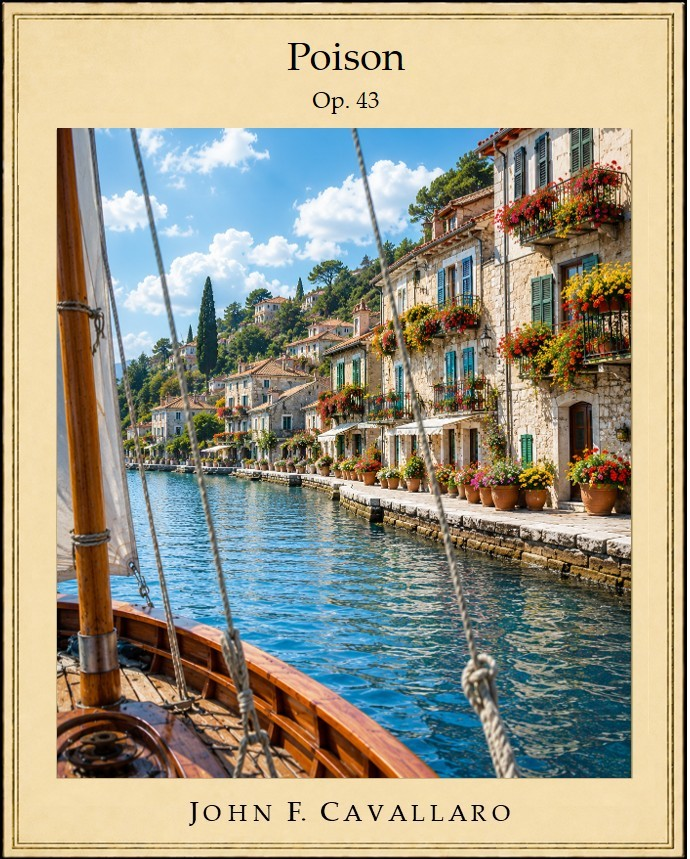
I composed Poison in 2016 on an unpublished poem by the Princeton-area poet Nicholas Wolf, written in memory of his son. The poem’s images—blue water and unmarked moorings, a potbelly stove, blooms on every ledge in colors—are the things the two of them once shared, the ordinary joys of a life together. The poem’s terrible turn is that grief has made those very memories unbearable, so that what was once happiness is now only poison. I never met Wolf’s son, but I set the poem to commemorate him.
The work opens in A minor, and is scored for six-part mixed chorus with equal divisi preferred. It runs without pause, Misterioso, ma non troppo lento, in 3/4. Its principal building block is a kind of contrapuntal invention: two voices begin a line in counterpoint, a third joins after a short delay, and the texture grows from there. That invention returns four times across the piece, each time in a different combination of voices: the men alone at the “simple grief” opening, the women at the flowering memories, a mixed trio at the first questioning, and the remaining mixed trio at “the glory of before.” This one idea is rung through changing vocal colors as the poem moves.
The men begin low and dark, their counterpoint carrying the first lines. The women enter only as the floral vistas bloom, a G-sharp lifting the music suddenly into the bright keys for the catalog of colors. This section is the sensuous heart of the piece: the voices name the colors, an energetic triplet leaps on “Luminous yellow,” and paired voices climb and descend through the chorus on “spicy breezes” in imitation. The texture is kaleidoscopic with memories.
But that brightness soon curdles. Again and again a radiant major arrival slips immediately into its parallel minor. As if sorrow is built into the harmony itself, each memory of joy turns instantly to grief as the poem insists it must. At the questioning of “How could tears… sweep away the gentle morning dew?” the pulse itself dissolves, the meter coming apart under a chain of fermatas, before the music gathers again, quieter and emptied, for the strange calm of “they do; they do.”
From that stillness the music begins its long way home. A vigorous antiphonal exchange of women and men on “the glory of before” descends through the keys until it arrives, chromatically and by slow degrees, back at the A minor where the work began. Once again, the opening music returns, with the same dark counterpoint in the men’s voices, note for note, but the words are now poisoned. Where the text once told of an overnight drift, it now cries, “full scope is suddenly poisonous,” grinding dissonances biting at the word each time it sounds. In response, the women crash in, forte, refusing to let the realization subside. The vocal line stack over a held open fifth like the pedal point of a fugue, the upper parts wailing “because” in long melismas, and descending scales cascade through the texture, with all voices eventually surging to an accented “now.”
The end is a slow collapse. Over the final bars, marked rallentando molto, the words “is poison” wither a step at a time, each chord slower and lower and stranger than the last. The sensation is that of slipping down a slope one cannot climb, and falling shapelessly to the floor. An acrid dissonance hangs for the entire penultimate measure, before the chord at last sinks to A minor. The poison settles, and the piece ends where the poem ends.
The audio clips offer two windows into the work. The first is the radiant central memory: the blue water, the colors, the spicy breezes. The second is the final descent, from the return of the men’s trio through the poisoned close. Here is Nicholas Wolf’s poem:
When eyes become vibrant bloodlines
Blurred by an overnight drift to unmarked moorings:
Pure blue water, a potbelly stove,
Blooms on every ledge in colors, red of course,
Luminous yellow, spicy breezes fringed in every hue.
How could tears astride pictures one would like to remember
Sweep away the gentle morning dew? They do; they do.
They do advance the glory of before
As if before is all you need.
But now full scope is suddenly poisonous,
Because now is poison.
© Nicholas Wolf, all rights reserved.
Opus 43 | SSATBB a cappella | English | 8:30
Licensed as a single-use PDF download
Up to 20 copies: $4.50/copy
Unlimited choral license: $90.00
PREVIEW
Customers Also Bought
Related products
-
Add to WishlistAdd to Wishlist
Ave Maria
$3.50 – $70.00Price range: $3.50 through $70.00 Select options This product has multiple variants. The options may be chosen on the product page -
Add to WishlistAdd to Wishlist
God, Forgive Us
$3.00 – $60.00Price range: $3.00 through $60.00 Select options This product has multiple variants. The options may be chosen on the product page -
Add to WishlistAdd to Wishlist
-
Add to WishlistAdd to Wishlist
Ode Thirteen
$3.50 Select options This product has multiple variants. The options may be chosen on the product page