Oratio
I composed Oratio for the 2015–16 Diabelli Contest in Munich, setting an adapted Latin version of the Wessobrunn Prayer (Wessobrunner Gebet). Believed to date from around 790 CE, it is one of the oldest surviving poems in the German tradition. Its few lines hold an immense vision: a memory of the time before creation, when there was no earth, no heaven, no tree or mountain, no star or sun or moon or sea. Yet in that nothingness, the one almighty God existed and the good spirits with him. The English translation on this page is my own.
The piece is built on a single dramatic withholding. The opening adagio tenebroso is in a dark B minor, slow and deliberate. The first line of the prayer rises from the basses alone, low and shadowed, gathering the baritones and tenors before handing the thought up to the women. All voices converge for a mezzo-forte swell at miraculum maximum (“greatest wonder”), then sink back.
From there I maintain the music in shadow for a very long time. The text catalogs the absences: no earth, no heaven, no tree, no mountain. The dynamic rarely rises above piano, and settles to sempre pianissimo. At ne ulla stella (“not even one star”), each voice takes up gentle staccato points of light, with the faintest of swells at the last stella.
A doloroso stretch follows for the unshining sun and the absent moon, the tessitura sinking low in every part. A brief swell touches the mare vastum (“vast sea”) with a prominent F-sharp-major chord at the cadence, poised as a dominant. At the timoroso, B minor returns for quando nil erat (“when there was nothing”) rendered sotto voce, breathy and timid, drifting low through ne finis, ne limes (“no ending, no limit”), the nothingness without bound.
The unusual dynamic restraint up to this point enables the glorious high point to come. At et erat (“and there was”), marked più risoluto though still hushed, the music gathers momentum, the phrase emerging from the texture and taken up by all. A steady maestoso crescendo swells until, at last, a full forte release at omnipotens Deus (“Almighty God”) blazes out quasi marcato in a radiant E-major chord. The acclamation repeats, growing louder and higher still, until it surges to the structural summit of the work, crowned high in the sopranos: divine light breaks into the void after all the held-back darkness.
A radiant aftermath follows. At the più mosso the mood opens; the voices declare God “most merciful of all,” and then running eighth-notes pass from the women to the men for the many good spirits gathered with him, brightening the harmony upward through E major and arriving finally at D major, the relative major toward which the music, born in B minor, has been heading.
The close is my own conceit. The prayer says sanctus (“holy”) only once, but I intended to convey the idea of cherubim and seraphim crying “holy” without end. Therefore I let each voice take up the word and repeat it, over and over, a mantra-like meditation on a gently rocking plagal cadence, marked in the score to be sung in the manner of those angels. Seven cries sound before the choir swells to sanctus est Deus (“God is holy”), and then seven more, entering voice by voice. The sanctus count is no accident: seven is the old number of completion and perfection, a fitting close for a text that contemplates the fullness of God before all things. The final repetition settles through the final plagal cadence onto a full, but warmly quiet D major.
The audio samples below offer two windows into the work. The first begins at the misterioso, measure 14, at the creation catalog; the second begins at the timoroso, measure 49, the hushed heart of the nothingness rising toward the great acclamation. Here is the Latin text, along with my translation:
|
Hoc disco inter mortuos esse miraculum maximum: Quod ne terra ne caelum esset, ne arbor ne mons esset, ne ulla [stella] ne sol luminavisset, ne luna canduisset, ne mare vastum. Quando nil erat, ne finis ne limes, et erat unus omnipotens Deus, omnium clementissimus, et multi erant eocum, spiritus benigni, et sanctus [est] Deus. |
This I learned among mortal men to be the greatest wonder: That there was neither the earth nor heaven, Nor was there any tree, nor mountain, Neither any [star] at all, nor did the sun shine, No moon gleamed, no vast sea. When there was nothing, no ending and no limits, There was the One Almighty God, Of all beings the greatest in grace, and many with him, Good spirits, and God [is] holy. |
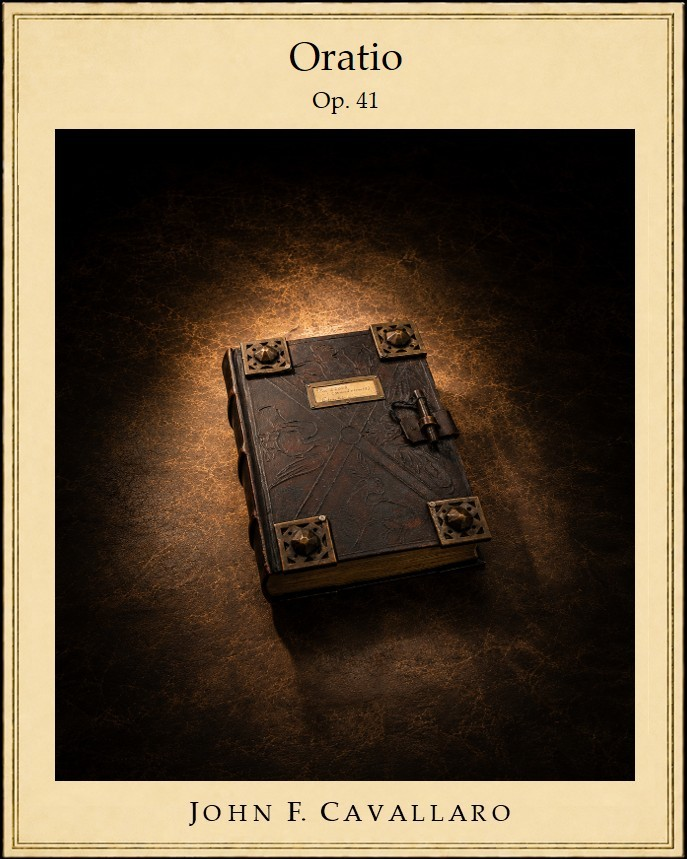
Photo credit: The volume shown in the AI-generated image above is a copy of the Wessobrunner Gebet bound manuscript, housed in the Special Collections section of the Firestone Library at Princeton University, https://graphicarts.princeton.edu/2013/09/29/wessobrunn-prayer
Opus 41 | SATB a cappella | Latin | 7:30
Licensed as a single-use PDF download
Up to 20 copies: $4.50/copy
Unlimited choral license: $90.00
PREVIEW
Customers Also Bought
Related products
-
Add to WishlistAdd to Wishlist
Como el Padre
$3.50 – $70.00Price range: $3.50 through $70.00 Select options This product has multiple variants. The options may be chosen on the product page -
Add to WishlistAdd to Wishlist
One Thing
$3.50 – $70.00Price range: $3.50 through $70.00 Select options This product has multiple variants. The options may be chosen on the product page -
Add to WishlistAdd to Wishlist
-
Add to WishlistAdd to Wishlist
Abba in Heaven
$3.50 – $70.00Price range: $3.50 through $70.00 Select options This product has multiple variants. The options may be chosen on the product page