Salve Regina
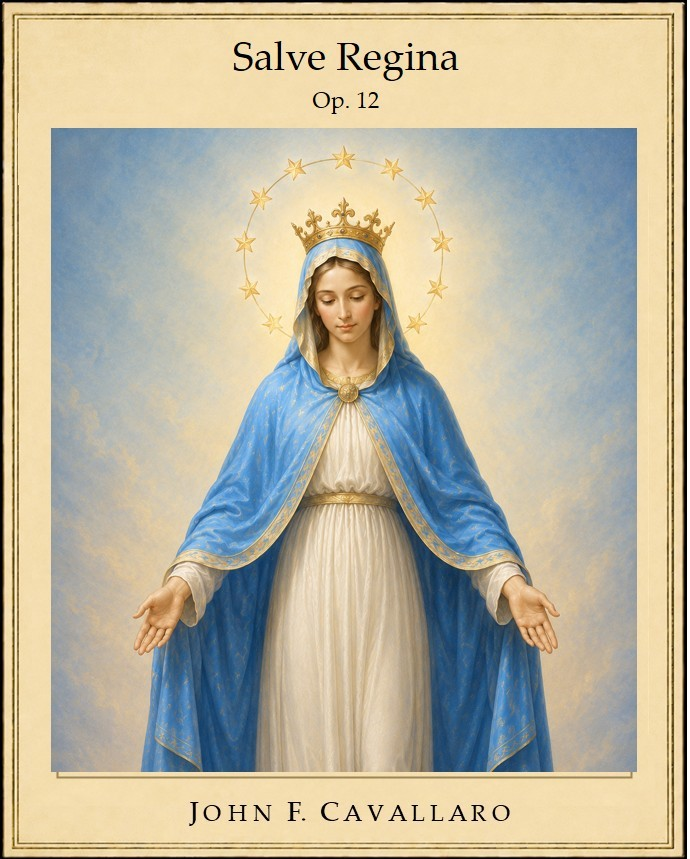
Salve Regina is a setting of the Marian antiphon, built on the Gregorian chant tune, for six-part mixed voices. It is dedicated to Holly Krafka and the New World Chorale of Wellesley, Massachusetts, who premiered the work in 2004. The piece is conceived contrapuntally, as a kind of cantus firmus motet. In each passage, one or two voices carry the chant tune in quarter notes while others spin counterpoint around it. My intended effect was that harmony would arise mainly from the voice-leading rather than being laid down in chords. The six-voice texture offers a wealth of subgroupings, and the chant passes freely among them, continually recolored by the line that holds it.
Somewhat unusual for me, this music maintains a single tonal center, rooted in D major throughout and never changing key signature. My goal was serenity drawn from that very rootedness. After the opening measure, where all six voices declare the harmonized Gregorian chant tune, the full ensemble is withheld, returning only at the great peaks, so the eventual tutti chords land as true arrivals. Two recurring gestures color the stillness: 1. At certain charged lines, the harmony shades toward D Dorian, a C-natural darkening the major brightness. 2. At strategic moments, quarter-note triplets (two to the bar) lend a momentary 6/8 lilt to the usual common-time flow.
The opening salutation, Salve Regina, mater misericordiae (“Hail queen, mother of mercy”), passes the chant from the inner voices up to the women, a single triplet stirring in the soprano at misericordiae against the mezzo’s even chant. The lament that follows, Ad te clamamus (“to you we cry”), moves through changing groupings. First, the three men’s voices are joined by soprano at exsules filii Hevae (“banished children of Eve”). Then, mezzo, alto, and tenor lines take up ad te suspiramus (“to you we sigh”). The music takes a darker turn in the men’s voices at gementes et flentes (“mourning and weeping”), settling onto a low B-minor chord at valle (“valley”).
At Eia, ergo, advocata nostra (“therefore, our advocate”) the music lifts to the higher voices, a brightening after the valley of tears just past. The mezzo and tenor lines carry the chant in parallel with particular weight on advocata nostra, the very heart of the prayer to Mary. Through illos tuos misericordes oculos (“your merciful eyes”) the mezzo holds the chant while the men’s voices enter by turns, the texture thickening toward what comes: tenors and basses forcefully declare Et in bare octave D’s, and at last the full six voices arrive together in the long-withheld tutti. The dynamic grows to fortissimo, on Jesum, the holy name. The mezzo and baritone maintain the chant tune in steady quarters while the other voices fill in homophonically at benedictum fructum ventris tui (“the blessed fruit of your womb”).
This plea for Mary’s regard comes around twice. The first nobis (“to us”) turns to the lower quartet with the baritone on the chant; at ostende (“show us”) the baritone passes the chant up to the mezzo but stays in the texture among the three women’s voices, and the word ostende is repeated in a soft cadence. That hush gives way to a second Et Jesum in the low quartet again, but quiet now, the parts widely spaced and marked con riverenza. The prayer depicts the pleading of souls here, and thus I believe the reverence is warranted. The second nobis post hoc brings every voice back, as a great crescendo swells on exsilium (“exile”) like a wail of lament — the children of Eve banished to earth — until the true summit arrives at ostende, fortissimo in all six voices, the quarter-note triplets everywhere at once, and a C-natural pulling the harmony into Dorian.
The texture thins as ostende is repeated and softened to pianissimo, and the basses and mezzos chant the first O clemens (“O clement”), marked dolcissimo and teneramente. The sopranos and then altos decorate the chant with quarter-note triplets, broad and unhurried. The tenor takes the chant at O pia (“O loving”), the light decoration continuing, and all voices gather at Virgo Maria. Finally, O clemens comes around again, but now the chant no longer lives in any single voice. Its essence is scattered among the parts while the harmony preserves the Gregorian feel. The texture is still spare for the moment, two to four voices weaving in and out with eighth-note tracery. At O dulcis (“O sweet”) the forces gather once again, the triplets returning in crescendo with the C-natural color now familiar, and the final text repeat saves its true peak for last: a huge tutti crescendo to fortissimo on the name Maria.
An Amen fughetta closes the work: the basses state the opening chant, and are tonally answered by the sopranos. Additional voices enter and exit to keep the texture light and the colors varied. A last shift into Dorian, the C-natural returning a final time, precedes the closing statement. The piece concludes with an extended plagal cadence to a long D-major chord in all six voices, its third carried by the altos alone, enabling the chord to ring steady and full.
Here are the Latin and English texts:
| Salve, Regina, mater misericordiae, vita, dulcedo, et spes nostra, salve. |
Hail, queen, mother of mercy, our life, our sweetness, and our hope, hail. |
| Ad te clamamus, exsules filii Hevae; ad te suspiramus, gementes et flentes, in hac lacrimarum valle. |
To you we cry, banished children of Eve, To you we sigh, mourning and weeping, in this valley of tears. |
| Eia, ergo, advocata nostra, illos tuos misericordes oculos ad nos converte; Et Jesum, benedictum fructum ventris tui, nobis post hoc exsilium ostende. |
Therefore, as our advocate, turn your merciful eyes towards us, and show us Jesus, the blessed fruit of your womb, after this our exile. |
| O clemens, O pia, O dulcis Virgo Maria. |
O clement, O loving, O sweet Virgin Mary. |
| [Amen] | [Amen] |
Opus 12 | SSATBB a cappella | Latin | 5:30
Licensed as a single-use PDF download
Up to 20 copies: $4.50/copy
Unlimited choral license: $90.00