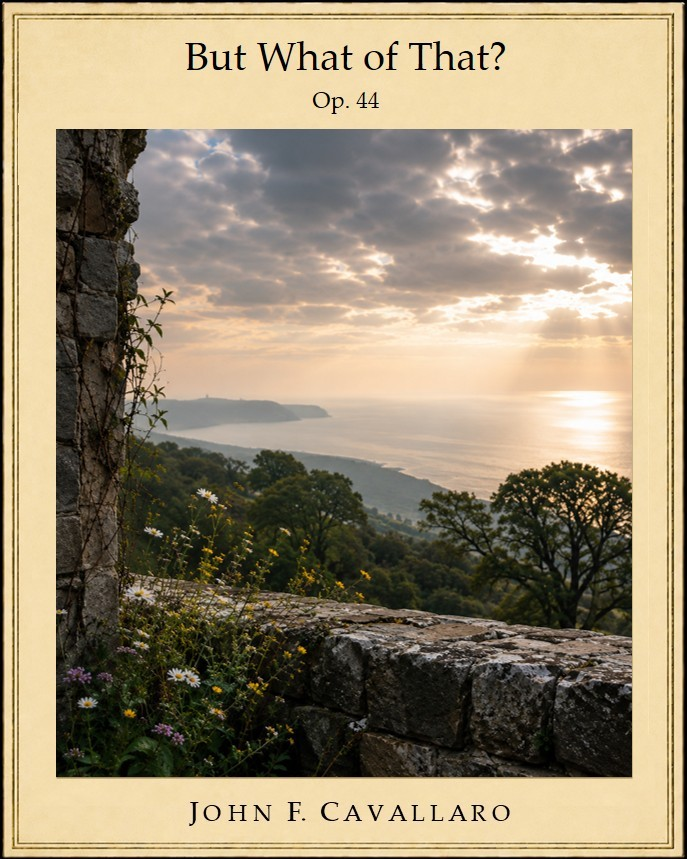
I wrote But What of That? in 2016 as a commission donated to Princeton Pro Musica for a fundraising auction. The winning bidder, soprano Carol Johnston, chose the text and specified the vocal range to suit her own voice. The song is dedicated to her.
Dickinson’s poem “I reason, earth is short” works its way through mortality in three tight stanzas: life on earth is brief, but perhaps heaven will somehow even the equation. Each stanza arrives at the same cool, unanswerable refrain: “But what of that?” I followed the text closely, and repeatedly let that refrain have the last word.
The setting is Adagio, in E minor. What began as a simple accompaniment turned almost unconsciously into a two-part keyboard invention, spinning counterpoint to the soprano. The piano tessitura lies well below the singer, and avoids doubling her line. The first stanza is plain and hushed, the piano kept softer than the voice. The second repeats the same music but one level louder.
After a brief interlude, the third stanza intensifies the mood via a long crescendo rising through “in heaven” to the song’s single high F-sharp on “even.” There the music turns tender, marked dolce, implying a wistful hope for the “new equation” that somehow makes things right. The last “but what… of that?” softens over a dissonant piano, and a brief coda settles through a suspension onto an open E chord, implying that the question remains unresolved, just as the poem leaves it.
The original soprano edition is written for a range of B3 to F-sharp5, a twelfth. On request and for an additional fee, I can provide a transposed version of this work to suit any voice part.
Here is Dickinson’s complete poem:
I reason, earth is short,
And anguish absolute.
And many hurt;
But what of that?
I reason, we could die:
The best vitality
Cannot excel decay;
But what of that?
I reason that in heaven
Somehow, it will be even,
Some new equation given;
But what of that?