If the Stars Fell
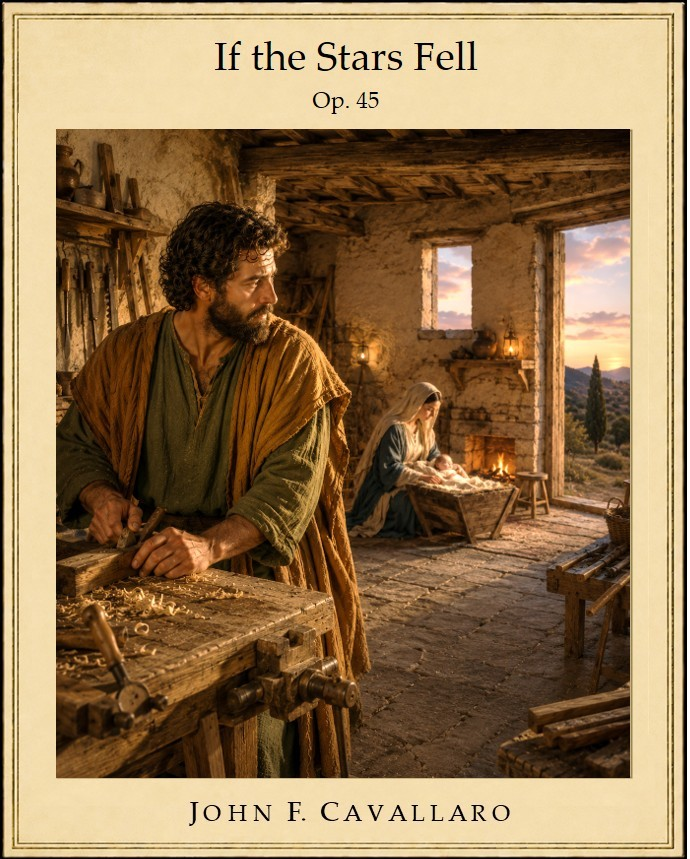
I wrote If the Stars Fell in 2017 for Jill Mueller, music director at the Church of the Nativity in Menlo Park, California, who had earlier commissioned my two English-language Masses. The text, “Joseph” by G. K. Chesterton, moves from earthly longing to a sudden vision of the Christ-child and the Virgin Mary.
The piece was written for a specific occasion, and its forces reflect it: an SATB chorus, a solo voice, and organ, with a string quartet and additional soprano, alto, and tenor soli all available but optional. The solo may be sung with supporting soli who may join where indicated. The optional string parts may double the choir. All that said, the work is complete with choir, organ, and a single soloist. The solo line is written for baritone in a modest range (E3 to C4); any tenor or bass may sing it as written, and any soprano or alto an octave higher.
The setting is moderato, in E minor. An eighteen-bar organ introduction lays out the principal theme in the pedal, marked by a leap upward of a sixth, on the word “stars” when the voices arrive. The two manuals take the pedal theme to form a three-part canon. From there the music unfolds as a call and response: the choir sings a line, and the solo voice answers, with the organ (and optional strings) doubling the singers throughout. The soloist’s responses rise to a forte at “and you loved me as I love you” before easing back, and a sustained pedal tone gathers the ensemble each time the choir returns.
At the third stanza the chorus declares the verse homophonically and forte. An unexpected harmonic turn on “Yes” leads to two luminous chords lifting the harmony toward A major at “foolish hour.” This harmony continues through “strength to a man.” A softer passage then follows. “He can demand, though not deserve” dwindles from mezzo-forte all the way to piano, a holding back that sets up the high point of the piece: a sudden forte on “seize he can,” the music seizing the tonic just as the word demands. Throughout this stretch, the soloists, helpers, and strings may all join the choir, swelling the texture as far as the forces allow.
The final stanza turns from desire to devotion. The choir presses forward, forte, the voices briefly scattering the text before drawing back together. The mood then softens entirely. The men alone, dolce, quietly sing in sweet thirds, “To see the Christ-child in the cot.” The organ and then the full choir echo them. In response, the women alone, hushed, answer with “the Virgin Mary by the fire.” At the last, the choir repeats the verse unaccompanied, and comes to rest in a warm E major, the third tucked low in the tenor voice. A brief organ coda closes the piece in that same quiet light.
Here is Chesterton’s poem:
Joseph
Of bliss and blasphemy came true,
If skies were green and snow were gold,
And you loved me as I love you;
O long light hands and curled brown hair,
And eyes where sits a naked soul;
Dare I even then draw near and burn
My fingers in the aureole?
Yes, in the one wise foolish hour
God gives this strange strength to a man.
He can demand, though not deserve,
Where ask he cannot, seize he can.
But once the blood’s wild wedding o’er,
Were not dread his, half dark desire,
To see the Christ-child in the cot,
The Virgin Mary by the fire?
Opus 45 | SATB with baritone solo, organ, and optional strings | English | 4:30
Licensed as a single-use PDF download
Up to 20 copies: $4.50/copy
Unlimited choral license: $90.00
PREVIEW