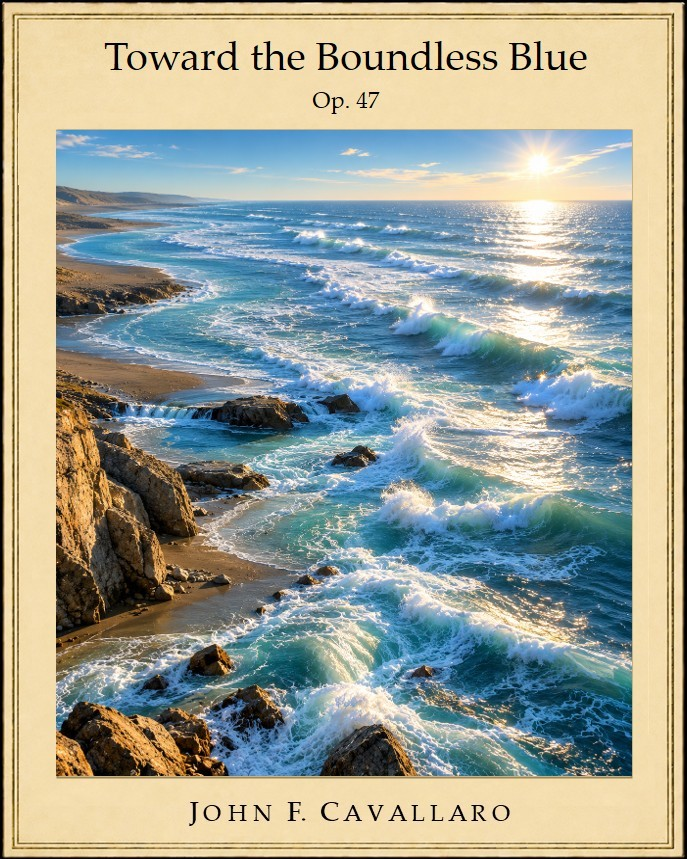
Toward the Boundless Blue
This anthem for SAB chorus (sopranos, altos, and a unified men’s baritone part), organ, and handbells is a setting of Rainer Maria Rilke’s “Alles noch nie Gesagte” from Das Stundenbuch (The Book of Hours), in my own English translation. It was commissioned by Stefanie Watson, organist and music director at Emanuel Lutheran Church in New Brunswick, New Jersey, and is dedicated to her pastor, the Rev. Dr. Jeffrey Eaton, a lover of Rilke. It was performed at the Sunday service celebrating his retirement.
I wrote this music to provide opportunities for text-painting, rather than to present technical challenges. I completed the English translation as part of the commission, so that the poem’s long sentences would fall more naturally on the voice. The SAB scoring can suit a choir of modest size, and the vocal writing stays within manageable ranges throughout, with only a few optional divisi spots (which the organ doubles).
The piece opens in A minor: three handbell chords over a pedal tone, then a dotted bell theme that rises through an open fifth, and repeats in the organ: a gesture of aspiration that colors the whole work. (The three-chord handbell figure serves as a punctuation mark, and recurs in various guises throughout.) The choir starts the theme first in unison, and then breaks into harmony at the poem’s first line. The last line of the opening stanza takes an unexpected harmonic turn to B-flat, a move that covertly foreshadows the modulations to come.
Rilke’s poem moves from inward devotion outward to the image of broad streams pouring into the open sea, and the music follows that lead. The harmony steadily migrates toward the flat side as the text reaches “this outpouring” and “the boundless blue.” At “the sea’s amassing, churning torrents” the organ turns percussive and detached, suggesting the crashing motion of waves. The author’s declaration to “proclaim you, like no one else before could to” heralds the peak of the work, led by a choral crescendo, and then an instrumental interlude in big chords crowned by a series of shimmering handbell shakes.
From there the opening mood returns as the organ and handbells recap the opening music. The choir sings the final verse much like the first, a little freer in its part-writing but in the same harmonic language. The choir’s last words, a prayer “earnest and solitary,” withholds its final cadence at “celestial hands.” The organ and handbells complete the journey, easing gradually to rest. The result is festive and devotional at once, grateful for the handbells that the dedicatee’s church could provide.
The first audio clip begins at measure 28, and the second at measure 88. Here is the text, in Rilke’s German and in my English translation:
|
Ich glaube an Alles noch nie Gesagte. Ich will meine frömmsten Gefühle befrein. Was noch keiner zu wollen wagte, wird mir einmal unwillkürlich sein. Ist das vermessen, mein Gott, vergieb. Aber ich will dir damit nur sagen: Meine beste Kraft soll sein wie ein Trieb, so ohne Zürnen und ohne Zagen; so haben dich ja die Kinder lieb. Mit diesem Hinfluten, mit diesem Münden in breiten Armen ins offene Meer, mit dieser wachsenden Wiederkehr will ich dich bekennen, will ich dich verkünden wie keiner vorher. Und ist das Hoffart, so lass mich hoffärtig sein für mein Gebet, das so ernst und allein vor deiner wolkigen Stirne steht. |
I believe in everything yet unstated, And yearn to free this reverent emotion. What no one dared expect, or wished created, Becomes for me an uncontrived devotion. My God, is it presumptuous? Forgive, For I only long to fittingly express The drive I feel compelled to freely give, Without frenzy, or qualm, or duress, Like how openly a child would love profess. With this outpouring, this grand confluence In broad streams toward the boundless blue Of the sea’s amassing, churning torrents, I hunger to declare and proclaim you, Like no one else before could do. If this is pride, then let me prideful be For my prayer, that stands Profound, and earnest, and solitary, Before your celestial hands. |
English translation © John F. Cavallaro, all rights reserved.
Opus 47 | SAB with organ and handbells | English | 6:00
Licensed as a single-use PDF download
Up to 20 copies: $4.50/copy
Unlimited choral license: $90.00
PREVIEW
Customers Also Bought
Related products
-
Add to WishlistAdd to Wishlist
Creator Alme Siderum
$3.50 Select options This product has multiple variants. The options may be chosen on the product page -
Add to WishlistAdd to Wishlist
God, Forgive Us
$3.00 – $60.00Price range: $3.00 through $60.00 Select options This product has multiple variants. The options may be chosen on the product page -
Add to WishlistAdd to Wishlist
We Speak of Love
$3.50 – $70.00Price range: $3.50 through $70.00 Select options This product has multiple variants. The options may be chosen on the product page -
Add to WishlistAdd to Wishlist
Ode Thirteen
$3.50 Select options This product has multiple variants. The options may be chosen on the product page