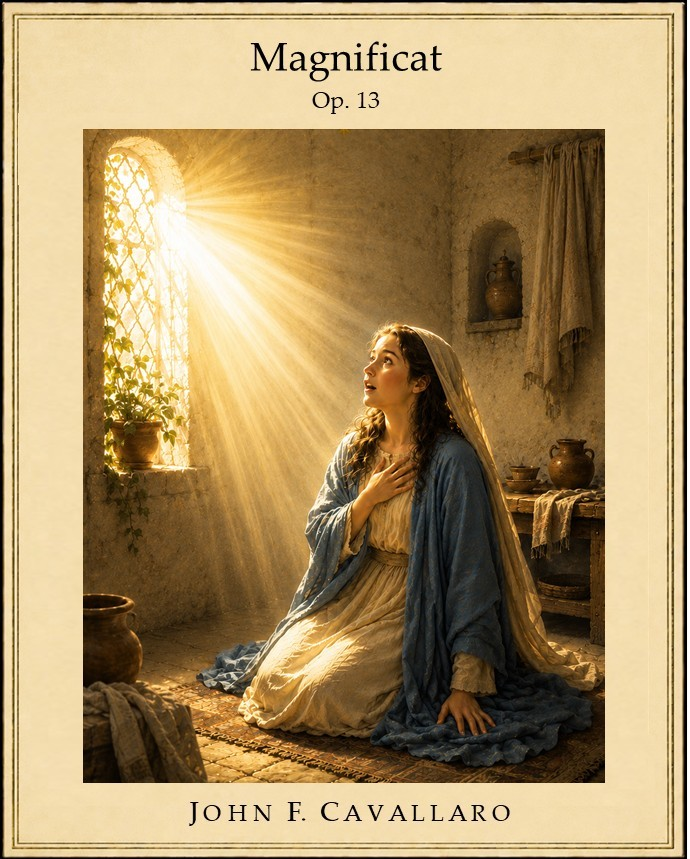
Magnificat
Magnificat is a setting of the Canticle of Mary (Luke 1:46-55), for a cappella SATB choir, marked Espressivo, ma non troppo lento. It sets the canticle in a single continuous span that ranges from placid stillness to dancing exuberance.
The work opens atonally and almost imperceptibly, with the choir softly humming a single unison middle C, one of the few pitches that sits comfortably in every voice part. Whole notes barely introduce motion, which then grows by degrees, with sopranos stepping up, tenors and basses down, and altos holding steady before drifting upward. The effect is that what started as a single pitch blooms into a widening series of clusters. The hum opens to Mag- midway through, and Magnificat repeats in tense, diminished harmonies until, on its third statement, it lands on F-sharp major, harmonically quite far from the opening. Thus the sound magnifies itself, as if to enact the title word. Anima mea (“my soul”) brings a slow dotted figure that settles toward B-flat, and further chromaticism carries Dominum (“the Lord”) to an E-major chord, where the voices close again to a quiet hum under a fermata.
This chord serves as the dominant of what comes next, in bright A major. Et exsultavit spiritus meus (“and my spirit rejoices”) breaks into a 6/8 dance, marked con moto. Sopranos state the theme first, followed by altos in harmony; tenors complete the 3-part texture through salutari meo (“my savior”). The dance continues at Quia respexit (“for he has regarded”), repeating the same voicing and entrances but now piano. Finally basses enter for the crescendo at ecce enim (“for behold”) to herald beatam me dicent (“they will call me blessed”), then surging again at omnes (“all”) before tumbling into a satisfying A-major cadence.
Quia fecit mihi magna (“for he has done great things”) launches a five-voice fughetta. The subject enters in the second basses, taken up a measure later by the baritones, then the tenors, then the altos; following a brief interlude, the sopranos enter last. Below the counterpoint, basses and baritones in octaves emphasize the power of qui potens est (“he who is mighty”). The momentum eases at et sanctum nomen ejus (“and holy is his name”), where the sopranos and basses stretch into sustained values while the altos and tenors weave in eighth notes. A few imitative, dancing figures bring the fughetta to another satisfying A-major cadence.
At et misericordia (“and his mercy”), the music turns to D minor, marked lo stesso tempo, that is, with the same underlying eighth-note pulse, but moving with a broader feel in dotted quarters. The sopranos quietly introduce a descending theme, piano, taken up by all four voices, forte, and then by a low quartet — alto, tenor, and the two bass parts — something of a barbershop sound, but with the alto on the top line where first tenors would be (this voicing avoids dividing the tenors). The texture is largely homophonic, darkened by a few brooding repetitions of timentibus eum (“those who fear him”), and comes to rest on a D-minor cadence.
One thread carries across the seam: the tenors, holding their high F from the D-minor chord, do not release it, but instead swell to an accented forte at Fecit potentiam (“he has shown strength”). The remaining voices fill in the booming F major, with the baritone line retained for fullness. The tenors sustain their high-F declaration through in brachio suo (“with his arm”) as the choir re-enters vigorously. At dispersit superbos (“he has scattered the proud”) descending eighth-note runs wander ever farther from F major, gathering new flats as they go, so that by the time the music reaches in mente cordis sui (“in the imagination of their hearts”), the tonal center has slipped away to enact the very dispersal the text describes.
A brightening at the cadence clears the accumulated flats, drawing back through C minor to C major for Deposuit potentes (“he has cast down the mighty”). Here the altos launch a jagged, leaping theme in large irregular intervals. The image I had in mind was high statues being toppled from pedestals. The basses answer the alto statement in canon at the octave, and then the tenors at the fifth. The lines knock against one another until the music lands, at humiles (“the lowly”), on an exultant E major. The pattern returns, altered, for esurientes implevit bonis (“the hungry he has filled with good things”). More drama arrives at divites dimisit inanes (“the rich he has sent empty away”), where a dark, sliding progression empties out onto the word inanes set as a bare, hollow open fifth, the C-major chord stripped of its third.
The Suscepit Israel (“He has helped Israel”) section works its way back toward the home key. The running eighth notes of et exsultavit gradually reappear, as trios of eighth notes eventually land the music at the home-key dominant E major at misericordiae suae (“his mercy”). At Sicut locutus est (“as he promised”), marked come sopra, the music of et exsultavit returns once more, using the same harmony beneath the new words, so that the canticle’s rejoicing comes full circle. Only the final bars depart, repeating in saecula (“forever”) to an A-major cadence voiced more openly than before, the tenors leaping up from A to E, the interval opening toward eternity.
The first audio sample begins at Quia respexit (measure 44); the second at Deposuit potentes (measure 136). Here are the Latin and English texts:
| Magnificat anima mea Dominum, et exsultavit spiritus meus in Deo, salutari meo, quia respexit humilitatem ancillae suae. Ecce enim ex hoc beatam me dicent omnes generationes. |
My soul magnifies the Lord, and my spirit rejoices in God, my Savior, for He has regarded the lowliness of His handmaiden. For behold, henceforth, all generations will call me blessed. |
| Quia fecit mihi magna, qui potens est, et sanctum nomen ejus, et misericordia ejus a progenie in progenies timentibus eum. |
For He who is mighty has done great things to me, and holy is His name, and His mercy is on those who fear Him from generation to generation. |
| Fecit potentiam in brachio suo, dispersit superbos in mente cordis sui. Deposuit potentes de sede, et exaltavit humiles. Esurientes implevit bonis, et divites dimisit inanes. |
He has shown strength in his arm, He has dispersed the proud in their hearts’ imagination. He has cast down the mighty from their seat, and has exalted the lowly. The hungry He has filled with good things, and the rich He has sent empty away. |
| Suscepit Israel, puerum suum, recordatus misericordiae suae, sicut locutus est ad patres nostros, Abraham et semini ejus, in saecula. |
He has helped Israel, His servant, in remembrance of His mercy, as He promised to our fathers, Abraham and his seed, forever. |
Opus 13 | SATB a cappella | Latin | 8:15
Licensed as a single-use PDF download
Up to 20 copies: $4.50/copy
Unlimited choral license: $90.00
PREVIEW
Customers Also Bought
Related products
-
Add to WishlistAdd to Wishlist
Pater Noster
$3.50 – $70.00Price range: $3.50 through $70.00 Select options This product has multiple variants. The options may be chosen on the product page -
Add to WishlistAdd to Wishlist
Salve Regina
$4.50 – $90.00Price range: $4.50 through $90.00 Select options This product has multiple variants. The options may be chosen on the product page -
Add to WishlistAdd to Wishlist
We Speak of Love
$3.50 – $70.00Price range: $3.50 through $70.00 Select options This product has multiple variants. The options may be chosen on the product page -
Add to WishlistAdd to Wishlist