Crucifixus
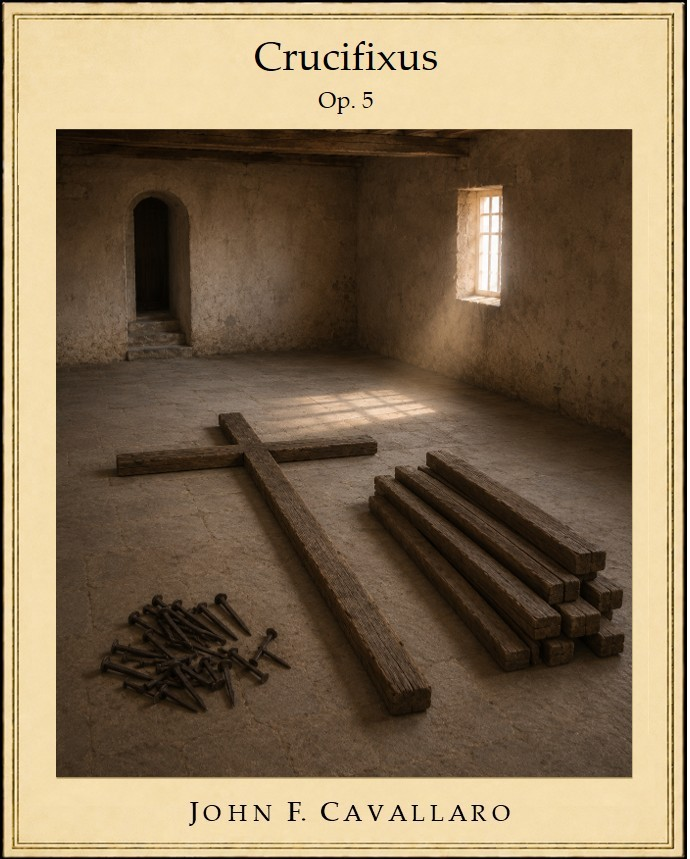
Crucifixus is a cycle of seven short meditations on the Crucifixion, for three men’s voices (tenor, baritone, bass), running about twelve minutes. Each meditation is built on a different Gregorian chant, and the work marks the beginning of my “Gregorian period.” The home key is D minor, but I sought variation of style and color from movement to movement. The writing is contrapuntal throughout. I utilized independent horizontal lines, so that the vertical harmony would arise as a consequence. The translations are my own, kept literal so that the Latin words might resonate more directly. The score asks that at least sixty seconds of silence be held between movements, for reflection, meditation, or prayer; the silences are part of the work. At the discretion of the director, the Latin and/or English text may be announced prior to each meditation.
I. Crucifixus etiam pro nobis. The first meditation, on text from the Credo, opens with a short D-minor introduction before the chant tune enters in the baritone line. The tenor and bass parts move in independent lines around it. The music shifts dramatically at passus (“he died”) — first a softening, then a great crescendo. Et sepultus est (“and was buried”) sinks softer and low in every voice, closing on a deep, open D chord.
| Crucifixus etiam pro nobis: sub Pontio Pilato, passus et sepultus est. |
He was even crucified for us: under Pontius Pilate, He died and was buried. |
II. Christus factus est. The second meditation sets the Good Friday gradual in F major. The chant is again in the baritone part. All three lines interweave, and extra ornamental attention is given on the word obediens (“obedient”). At usque ad mortem (“even to death”) the harmony darkens, adding flats, before a cadence on an open F chord. The mortem text returns reharmonized, signaling a key change to C minor. The counterpoint grows dissonant, climbing to a deathly peak high in all three parts on the third repetition. A great crescendo presses without breath through a fortissimo on crucis (“cross”). Finally, the dynamic ebbs as mortem crucis is repeated and falls away, closing on an open C chord.
| Christus factus est pro nobis obediens usque ad mortem, mortem autem crucis. |
Christ was made obedient for us unto death, even to death on the cross. |
III. Posuerunt. The third meditation returns to D minor, the chant in the baritone part amid the other parts’ independent lines. The chant tune begins with a striking rising fifth and a melisma on posuerunt (“they placed”). After a diminuendo at scriptam (“written”), the music intensifies. As the inscription itself is named — Iesus Nazarenus (“Jesus the Nazorean”), the chant tune shifts to the bass part, and the other two voices wail high above it, the tenor reaching a high B-flat and the baritone a high F on the Holy Name (optional alternative notes are provided). Rex Iudeorum (“King of the Jews”) follows to a cadence on an open D chord. The text then repeats from Iesus with further wailing, before arriving at a D-minor cadence, with the fifth in the bass leaving the chord a little less settled.
| Posuerunt super caput eius causam ipsius scriptam: Iesus Nazarenus, Rex Iudeorum. |
They placed above his head something which was written: Jesus the Nazorean, King of the Jews. |
IV. Ait latro ad latronem. The fourth meditation sets the penitent thief’s words from Luke’s Gospel in E-flat major using a homophonic, parlando texture. The chant lies in the baritone line amid a rather plain harmonization, the spoken directness suiting one dying man’s words to another. Activity quickens at hic (“this man”), as the harmony shifts to the relative C minor and rises in a crescendo to quid fecit? (“what has he done?”). The text resumes at Memento mei, Domine (“Remember me, Lord”), where the style returns to the contrapuntal approach of the earlier meditations. The chant tune is now in the bass with free counterpoint above. As the tonality deepens to F minor, homophony returns for a final regnum tuum (“your reign”). The final statement is almost pleading, marked dolcissimo, coming to rest in the relative major, A-flat.
| Ait latro ad latronem: Nos quidem digna factis recipimus. Hic autem, quid fecit? Memento mei, Domine, dum veneris in regnum tuum. |
The one thief said to the other: We are only receiving what we deserve, but this man, what has he done? Remember me, Lord, when you come into your reign. |
V. Sed unus militum. The fifth meditation, in D minor and marked agitato, sets the piercing of Christ’s side from John’s Gospel, with the chant in the baritone line. Sharp accents on lancea (“lance”) strike like the spear-thrust itself, and a repetition of lancea latus eius aperuit (“opened his side with a lance”) drives the accents harder, the voices crossing in a jagged texture. An accelerando at et continuo (“and at once”) keeps the baritone part on the chant in a narrow band of pitches while the tenor and bass scream above, fortissimo, depicting the moment of impact. Then, meno mosso, sanguis et aqua (“blood and water”) floods into a six-part chord on aqua, but now in D major, piano, under a long fermata. The blood and water from the wound are rendered not as horror, but as a sign, the one beam of light in the movement. In many ways, it is the emotional climax of the work.
| Sed unus militum lancea latus eius aperuit, et continuo exivit sanguis et aqua. |
But one of the soldiers opened his side with a lance, and blood and water streamed out. |
VI. Crux fidelis. The sixth meditation is a turn from narration to praise, addressing the cross itself in the words of the Good Friday hymn. In 3/4 and a bright G major, the chant tune begins in the baritone line, the tenor line echoing it in variation a dynamic softer. The voices trade roles as the text unfolds: the tenor takes the chant tune at arbor una nobilis (“one noble tree”) while the baritone variation is in a softer dynamic. Finally the bass part enters with the chant tune at nulla only to pass it back to the baritone at silva. Individual vocal lines light up fronde, flore, germine (“frond, flower, shoot”) in turn, cadencing on an open D. The dulce lignum (“sweet wood”) section softens, marked dolce, swelling to a crescendo at sustinens (“bearing”); the text then returns in a lighter, almost dancing mood. Repetitions of dulce pondus (“sweet load”) build forte to a great fermata and a sustinens on a second-inversion D-major chord, the divided tenors high on F-sharp and A. One final repeat draws out a series of long, slow suspensions on sustinens, settling at last onto a root-position D major chord.
| Crux fidelis, inter omnes arbor una nobilis, nulla talem silva profert fronde, flore, germine: dulce lignum, dulci clavo, dulce pondus sustinens. |
Faithful cross, the one noble tree among all, no other in the forest offers such a frond, flower, or shoot: sweet wood, with sweet nails, bearing a sweet load. |
VII. Amen. The cycle closes by returning to the music that opened it. Meditation VII begins as Meditation I did, now on the single word Amen. But where the first meditation held its course, here the counterpoint breaks into running eighths in every voice, gathering into a brief ten-bar fughetta that draws the harmony from D minor toward G. A repeat sends the fughetta around twice before it comes to rest on an open G chord. The cycle’s final Amen frames the whole work between its opening D and this last, plagal repose.
| Amen. | Amen. |
The first perusal score shows Meditation I and sample pages from II, III, and IV; its accompanying audio clip is Meditation I complete. The second perusal score shows Meditation V and sample pages from VI and VII; its accompanying audio clip is Meditation V complete.
Opus 5 | SATB a cappella | Latin | 19:00
Licensed as a single-use PDF download
Up to 20 copies: $4.50/copy
Unlimited choral license: $90.00
PREVIEW
Customers Also Bought
Related products
-
Add to WishlistAdd to Wishlist
O Magnum Mysterium
$4.50 – $90.00Price range: $4.50 through $90.00 Select options This product has multiple variants. The options may be chosen on the product page -
Add to WishlistAdd to Wishlist
Pater Noster
$3.50 – $70.00Price range: $3.50 through $70.00 Select options This product has multiple variants. The options may be chosen on the product page -
Add to WishlistAdd to Wishlist
Salve Regina
$4.50 – $90.00Price range: $4.50 through $90.00 Select options This product has multiple variants. The options may be chosen on the product page -
Add to WishlistAdd to Wishlist
Levate in Excelsum
$3.50 – $70.00Price range: $3.50 through $70.00 Select options This product has multiple variants. The options may be chosen on the product page