At the Break of Christmas Day
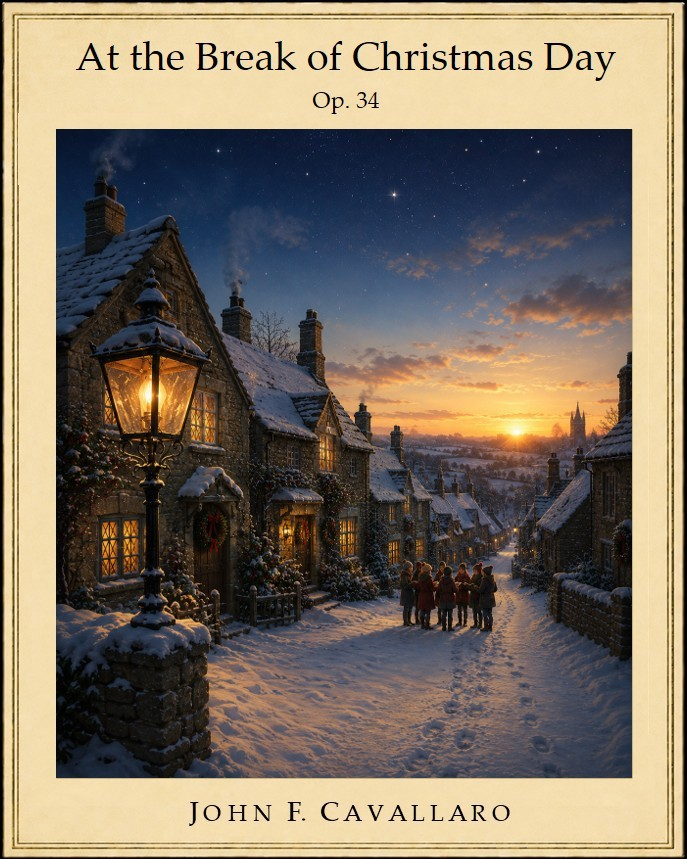
I composed this Christmas setting in 2013 on a commission from Schola Cantorum of Mountain View, California, for the ensemble’s fiftieth-anniversary season, and dedicated it to them. Their music director, Greg Wait, who also directed the Stanford Memorial Church Choir, chose the text from several I offered him. He picked Margaret Deland’s poem “The Waits,” whose title happens to be his own surname. The original and premiered scoring is for SATB chorus with brass quintet; an organ version serves where the brass quintet is unavailable.
The poem takes its title from the ancient tradition of “waits,” musicians employed by British towns from medieval times. Among their duties, waits would wake the townsfolk on dark winter mornings by playing outside their windows. After the office was abolished in 1835, the name survived in the “Christmas waits,” bands of singers and players who caroled through the streets at night during the Christmas season. Deland’s poem captures the idea of far-off sound of carolers heard at daybreak on Christmas morning, drawing nearer as the sky brightens.
The work begins in E-flat major. The horn opens by intoning the theme that recurs throughout the piece, and the first stanza follows with the full chorus in unison over spare brass, depicting the carolers’ refrain, “Cease to mourn, for Christ is born, peace and joy to all men bringing.” Three-part men’s voices then take on a narrator’s role, telling of the children heard singing far away, while dolce sopranos and altos become those children, supported only by sustained chords in horn and tuba. A brief brass interlude returns the narrators for the second stanza, which broadens at “Hear them singing” as all voices enter espressivo and forte. The women take up the children’s music once more, shifting the tonality to G major, and now singing a little louder and in three-part harmony.
At the third stanza everyone joins for “Merry Christmas, hear them say,” each short phrase accompanied and interleaved with brass. “May the joy of Christmas Day” turns aside to a deceptive cadence in E major before regaining G at “brighter.” A brass interlude bridges to the chorus’s invitation to “join their singing,” with that word heralding the music’s return to the home key of E flat.
A meno mosso, a cappella choral section follows, built on a new theme resembling an inverted version of the original. The sopranos begin and the other voices enter in turn, something like a double canon, leading to the setting of “all Love’s treasures.” The full chorus sings that line first piano and dolce, then crescendos to a broad forte on “treasures.” (I understood that word to mean the salvation of humankind that the Christ child brings.) The three-part men narrate a final statement of the text, again piano and dolce, which thins to pianissimo and dolcissimo as all six parts enter, sopranos and basses divided. Trombone and tuba slip in discreetly beneath the chorus, leading to the trumpets’ echo of the “treasures” melody, decorated by ascending scales first in the trombone and then the horn, until a long fermata on an E-flat chord settles into the cadence.
In recapitulation, the horn declares the original theme once more, the quintet joining in music like the opening, and introducing a short fughetta doubled in the brass. Its subject is that same horn theme: the basses begin, the tenors follow a measure later, then the altos, then the sopranos, with free counterpoint spinning out in all the voices. A poco allargando gathers everyone to forte at “is born,” held tenuto on a surprisingly bright G-flat-major chord that then slips downward via an unexpected F-flat passing tone in the bass to a radiant E-flat-major chord on “born.” The quintet repeats that same figure in half notes to close the work fortissimo in the home key, the first trumpet crowning it on a high B flat.
The first audio sample is from the opening of the work. The second begins at measure 111, the lead-in to the choral “Join their singing” entry. Here is the full text:
Through the frosty starlight ringing,
Faint and sweet and far away,
Comes the sound of children, singing,
Chanting, singing,
“Cease to mourn, for Christ is born,
Peace and joy to all men bringing!”
Growing stronger, sweeter, clearer,
Noiseless footfalls in the snow
Bring the happy voices nearer;
Hear them singing,
“Winter’s drear, but Christ is here,
Mirth and gladness with Him bringing!”
As the East is growing lighter;
“May the joy of Christmas Day
Make your whole year gladder, brighter!”
Join their singing,
“To each home our Christ has come,
All Love’s treasures with Him bringing!”
Opus 34 | SATB with Organ | English | 7:30
Licensed as a single-use PDF download
Up to 20 copies: $4.50/copy
Unlimited choral license: $90.00
Brass parts (Trumpets I and II, Horn, Trombone, and Tuba) sold as Opus 34A: $35.00
Contact me for details.
PREVIEW
Customers Also Bought
Related products
-
Add to WishlistAdd to Wishlist
Ubi Caritas
$3.50 – $70.00Price range: $3.50 through $70.00 Select options This product has multiple variants. The options may be chosen on the product page -
Add to WishlistAdd to Wishlist
Cantate Domino
$3.50 – $70.00Price range: $3.50 through $70.00 Select options This product has multiple variants. The options may be chosen on the product page -
Add to WishlistAdd to Wishlist
We Speak of Love
$3.50 – $70.00Price range: $3.50 through $70.00 Select options This product has multiple variants. The options may be chosen on the product page -
Add to WishlistAdd to Wishlist
Missa Brevis Orbis Factor
$4.50 – $90.00Price range: $4.50 through $90.00 Select options This product has multiple variants. The options may be chosen on the product page