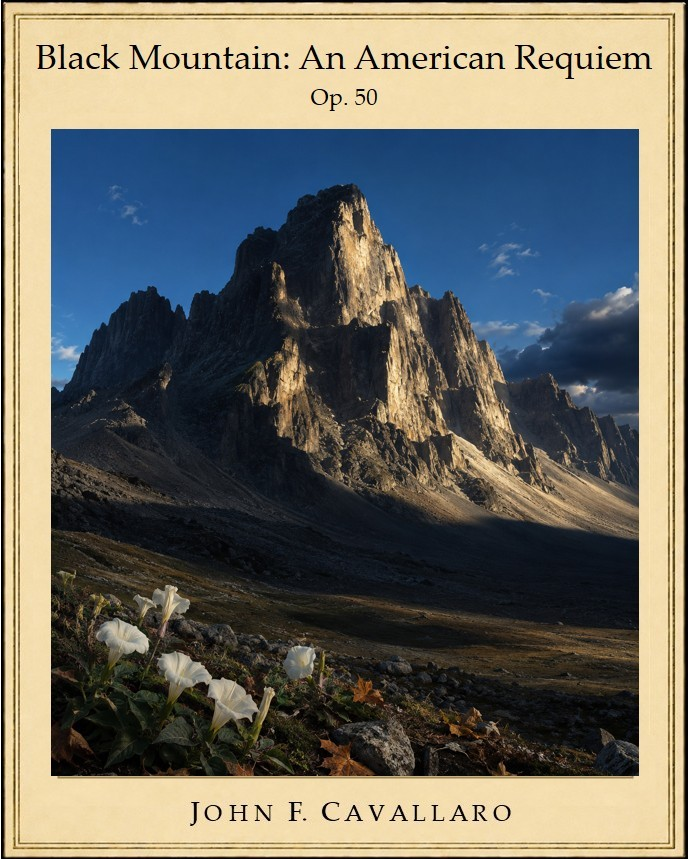
Black Mountain: An American Requiem
I am seeking to premiere this work, in remembrance of the 25th anniversary of the 9-11 terrorist attacks. The conductor’s score, an MP3 audio file, and extensive program notes are available at no cost. I am not requesting compensation for a premiere, just an opportunity for the work to be heard.
Conductor’s ScoreAudio FileNotes
Black Mountain: An American Requiem is a deeply personal and emotionally charged work that explores themes of life, death, and the aftermath of loss. Dedicated to the 2,977 Americans who lost their lives on September 11, 2001, and to the victims and survivors of terrorism everywhere, this Requiem traces a psychological journey ensuing from the events of that terrible day: a journey that we faced both as individuals and as a nation, and which we continue to process. The piece interweaves dissonant harmonies, shifting rhythms, and profound texts to create a sonic landscape that reflects the psychological complexity of human tragedy.
I drew the texts for this composition from the works of Edgar Lee Masters, along with a single poem by Emily Dickinson. All are in the public domain. Masters’ Spoon River Anthology and Starved Rock provide a stark, humanistic exploration of life, death, and the inescapable connection they share. Dickinson’s “It struck me every day” complements Masters’ treatment of these profound themes by reflecting on the sudden, transformative nature of loss.
I sought out American poetry that resonated with the thematic material of those tragic events, but avoided religious references, except for the word Requiem in the title itself. The texts I chose make no mention of any deity, judgment, reward, or punishment in an afterlife. The focus remains on universally reflective but secular ideas, offering a humanist treatment free from dogma and supplication. My intention with this approach was to foster broad inclusiveness and to respect the emotional backgrounds and personal experiences of all listeners, whether or not they identify with a faith tradition.
I began writing this piece in 2002, on the first anniversary of the 9/11 attacks. On that day, choirs around the world sang the Mozart Requiem at the precise hour (local time in each time zone) that the first tower was struck. As a graduate student at the time, I sang the Mozart Requiem at Stanford’s Memorial Church that morning. I remember thinking afterwards that although the Mozart is no doubt a masterpiece, it was curious that there seemed to be no appropriate American composition to sing on such an occasion, thinking that an American work, in American English, by an American composer, would have been especially appropriate. Work on this piece began that afternoon.
The image of the Black Mountain derives from themes explored in Edgar Lee Masters’ Starved Rock, where a black mountain serves as a metaphor for the interconnections between life and death. The blackness of the mountain symbolizes both the darkness of death and the source of creation, where the light of life is mixed with shadows to form the spectrum of human experience. This Requiem aims to honor the complexity of these interconnected themes.
The American Requiem subtitle took inspiration from Johannes Brahms’ famous German Requiem (Ein deutsches Requiem). I took the cue from Brahms who also favored his own vernacular over the traditional Latin, for the express purpose of make his chosen texts more directly accessible to his audiences, and to bring solace and healing to the living.
With a performance time of approximately 40 minutes, the work unfolds in a single movement. However, changes in the text indicate transitions to new but often thematically related material. The objective was to depict an emotional interchange, from the initial shock and rage at the events themselves, to the intense sadness at the inconceivable grief and loss, and back again. Ultimately, fueled by the realizations that the departed live on as we honor their memory, and that peace in the end must arise out of forgiveness, the work concludes by presenting the potential for a transformative moment of hope.
Shock and Rage Take Hold
Low strings solemnly state the opening C-minor theme, dark and brooding, with a conspicuous tritone. Dissonances build, release, build again, and finally release again as the chorus establishes the principal metaphor in the text.
From “Hymn to the Dead” in Starved Rock:
The light of life is mixed,
Whereof all hues are made:
All thoughts, all lofty wanderings of the soul,
All meanings, divinations
Of briefest hours, and frailest joys,
All wonders of the spectrum of the soul
Out of life and death!
The theme continues with a solo violin, gently accompanied by low brass. The chorus then returns with a fuller texture, depicting a broad variety of colors and textures in the “spectrum” of hues that Masters describes.
A slightly more driving tempo marks a shift in the orchestral mood. A prominent viola solo with a spare accompaniment establishes a new theme, modulating to A-minor as the feelings of distress and anxiety increase. The chorus erupts with rage at the moral conflict.
From “Julian Scott” (#228) in The Spoon River Anthology:
The justice of others, injustice to me.
Clashing chords and sforzando outbursts in the extremes of range punctuate the cognitive dissonance. Sections of the chorus repeat their anguish at the juxtaposition of justice and injustice that Masters depicts.
As the commotion wanes, the strings introduce the first of two substantial fugues. Agitated first violins scratch out a highly angular subject derived from the previous material. Second violins answer, followed in turn by violas and cellos. Woodwinds then enter the fray, one by one, followed by brass, and tympani strikes provide rhythmic emphasis throughout. Stretches of free counterpoint with false entrances, strettos, and pedal points abound until a solo trumpet concludes the fugue by declaring a descending Phrygian scale, notable for its flattened second degree, and for its intense expression of both sorrow and anger.
Sadness and Grief Overwhelm
Once the furious emotions of the fugue are temporarily spent, the chorus reappears with the same text, and similar thematic material, but this time lento e doloroso, and accompanied only by low strings. An intensely sad wind quartet follows the singers’ lead, depicting an unabating melancholy. The chorus continues, describing a poignantly sorrowful darkness.
From “Hymn to the Dead” in Starved Rock:
Which darkens heaven,
And shadows earth […]
Darkness to eyes of flesh.
The despondency redoubles, as a new choral theme invites a contemplation of the departed, and the aching absence felt by those left behind.
From “Hymn to the Dead” in Starved Rock:
Layer on layer,
[…] So do the spirits of those departed
Enrich our soil of life
With delights, wisdoms, purest hopes,
And shapes of beauty.
When there is nothing more to say, layers of sound in the winds and brass sonically depict the layers from Masters’ riveting image.
Shock and Rage Return
A gradually building orchestral interlude in E minor signals the return of unresolved anger and conflict. The 5/4 meter underscores the shifty instability of our emotional footing. A climactic eruption introduces the second fugue, still in 5/4. Chorus basses open with percussive words of discord and contradiction.
From “Julian Scott” (#228) in The Spoon River Anthology:
Their reasons for life, reasons with me for death.
Here, the orchestration suddenly becomes quite bare, with only pizzicato strings and meager doublings of the vocal lines. The dissonances within the fugue reflect the internal conflict of the text. After the basses open, tenors, altos, and finally sopranos enter with their own renditions of “reasons for life” and “reasons for death.” Pedal points in tritones and strong shifting accents take us again from a fortissimo climax to a series of wailing Phrygian scales, descending from winds and brass, and echoed by strings.
Sadness and Grief Remain
Accompanied only by a pianissimo tympani roll and softly doubling strings, the chorus sings the Dickinson poem in a Phrygian-inspired melodic chant:
Poem #132 of “Part IV, Time and Eternity” in Complete Poems:
The lightning was as new
As if the cloud that instant slit,
And let the fire through.
It burned me in the night,
It blistered in my dream;
It sickened fresh upon my sight
With every morning’s beam.
I thought that storm was brief,
The maddest, quickest by;
But Nature lost the date of this,
And left it in the sky.
The first verse is set in unison, with subsequent verses increasing in harmonic variation and richness of accompaniment, adding in muted horns, and finally flutes and trumpets. A contemplative coda in the strings echoes the chorus’ concluding strain. The sorrow, however, continues without a break into the next section of text: From “Edith Conant” (#185) in The Spoon River Anthology:
Only the burning sun and the quiet stars are the same.
And we — we, the memories, stand here in awe,
Our eyes closed with the weariness of tears.
Dissonant harmonies set the dark mood of this theme, an intervallic inversion of the opening statement, this time in E-minor. To underscore the “weariness of tears,” a series of chime strikes resounds an unrelenting reminder, as the horns lead a recall of the second fugue theme.
Hope and Forgiveness Emerge
After the sorrow is once again exhausted, a descending Phrygian scale in the violins introduces a transition to what holds the promise of lasting peace and new hope.
From “Mary McNeely” (#101) in The Spoon River Anthology:
Bringing infinite repose.
Oh, ye souls who have made life
Fragrant and white as tube roses
From earth’s dark soil, eternal peace!
The phrase “infinite repose” heralds an uplifted spirit. Several modulations, at such moments as at “fragrant and white” and “dark soil” emphasize a transcendence away from the heavy emotions just experienced. The chorus holds a solemnly suspended G-minor chord to signify the “eternal peace.”
As the conclusion of the work approaches, the original themes return once more, but now in a much higher register, and shimmering with a serene optimism. A noble horn solo, accompanied by high violins, introduces the choral statement of the final text. From “Anne Rutledge” (#200) in The Spoon River Anthology:
And the beneficent face of a nation
Shining with justice and truth.
After the first line, almost all of the orchestra drops out, leaving only an occasional solo chime as accompaniment, which at once represents the “justice and truth.” Our hope now is that the nation and its people emerge from tragedy stronger and more committed to renew our world. The chorus repeats “justice and truth” ending on an open C chord. Starting low, full strings gradually return, leading us via C major to a fortissimo resolution: a sunburst of brilliant, unprepared E major, further brightened by high flutes, chimes, and a triangle roll. A long diminuendo in high strings concludes the work.
The full score and MP3 audio file are available at the links above.
The perusal score and first audio clip below are from the opening of the work. The second perusal score/clip starts at the orchestral fugue.
Opus 50 | SATB with orchestra | English | 40:00
Contact me for score and parts information.
Parts engraving by Galindo Musix Services
PREVIEW
Customers Also Bought
Related products
-
Add to WishlistAdd to Wishlist
Salve Regina
$4.50 – $90.00Price range: $4.50 through $90.00 Select options This product has multiple variants. The options may be chosen on the product page -
Add to WishlistAdd to Wishlist
One Thing
$3.50 – $70.00Price range: $3.50 through $70.00 Select options This product has multiple variants. The options may be chosen on the product page -
Add to WishlistAdd to Wishlist
We Speak of Love
$3.50 – $70.00Price range: $3.50 through $70.00 Select options This product has multiple variants. The options may be chosen on the product page -
Add to WishlistAdd to Wishlist
Abba in Heaven
$3.50 – $70.00Price range: $3.50 through $70.00 Select options This product has multiple variants. The options may be chosen on the product page