Levate in Excelsum
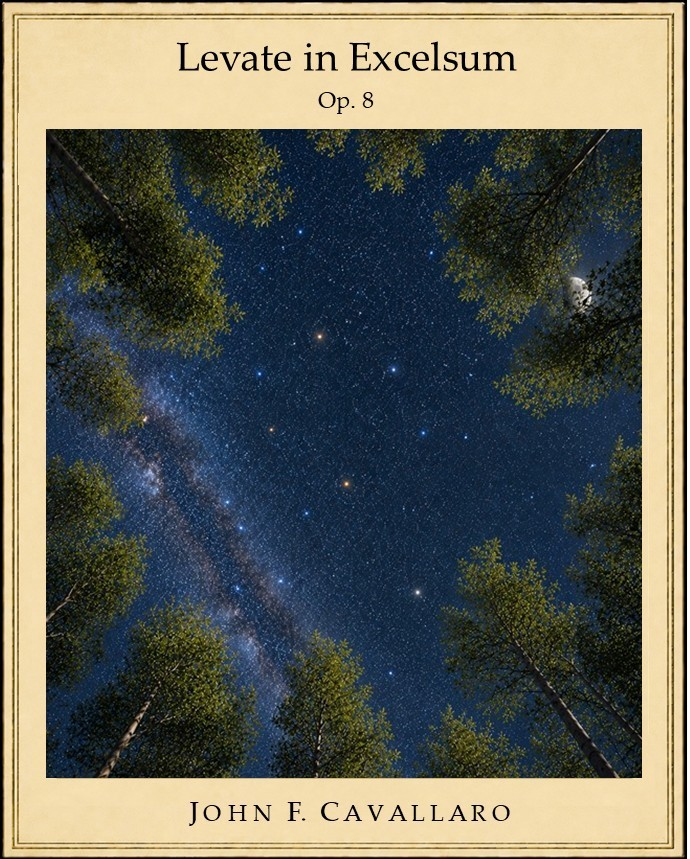
Levate in Excelsum is a setting of Isaiah 40:26, for a cappella SATB choir, dedicated to the crew of the Space Shuttle Columbia, lost on February 1, 2003. I completed it in Palo Alto five weeks later, on March 5 of that year. The first line translates, “Lift your eyes and look to the heavens.” The words had reached me through President George W. Bush’s address in response to the disaster. I found the sentiment profoundly moving and built the piece on that text, given below.
This work carried a personal resonance beyond the public grief. The department at Stanford where I received my MS and PhD degrees (Management Science and Engineering) is devoted to risk analysis and probabilistic reasoning. Our faculty had been involved in the shuttle’s manufacturing-process design and in the investigation that followed, and the department chair was called to Washington to testify before Congress. The disaster was, for those of us in that work, both a national loss and a professional one.
The music is in G minor, but an added ninth (A natural) keeps slipping into the harmony, lending a drifting, weightless quality. The texture is largely homophonic, with the syllables falling more or less together across the voices. The first two verses share the same music through militiam eorum (literally “the army of them,” meaning a great multitude). At et omnes, four-part women’s voices emerge to declare that the maker of the starry host calls each one by name, omnes ex nomine vocat. The full choir repeats the declaration with an intense crescendo to fortissimo, the loudest dynamic mark of the piece. Four-part men’s voices take over at prae multitudine fortitudinis (“because of his great power”), moderate at first and peaking at fortitudinis. Again, the full choir is employed for the repeat, followed by a dimming to a quiet G-minor at virtutisque eius (“and his strength”).
At this point, the tempo relaxes to poco meno mosso, più tranquillo. Beginning with the women, a chain of suspensions settles again and again onto B-flat major, repeating neque unum (“not one”) over and over, as if counting each of the stars. Divided men’s voices sustain the sonority, with at least one vocal line always carrying the B-flat, creating another weightless passage. The word reliquum (“missing”) opens into an expansive crescendo, and the word fuit (“was”) lands on a long but non-functional dominant seventh, floating under a long diminuendo and fermata rather than pulling anywhere. A repeat of the final phrase recalls the work’s opening sonority: a G-chord with the added ninth and no third, matching the drifting, weightless color that began the piece. Thus, the music ends where it started, its color intact, and nothing lost.
The audio sample begins at measure 15. Here are the Latin and English texts:
| Levate in excelsum oculos vestros et videte: Quis creavit haec? Qui educit in numero militiam eorum, et omnes ex nomine vocat. Prae multitudine fortitudinis et roboris virtutisque eius, neque unum reliquum fuit. |
Lift your eyes and look to the heavens: Who created these things? He who brings out the starry host one by one, and calls them each by name. Because of his great power and mighty strength, not one of them was missing. |
Opus 8 | SATB a cappella | Latin | 4:00
Licensed as a single-use PDF download
Up to 20 copies: $3.50/copy
Unlimited choral license: $70.00