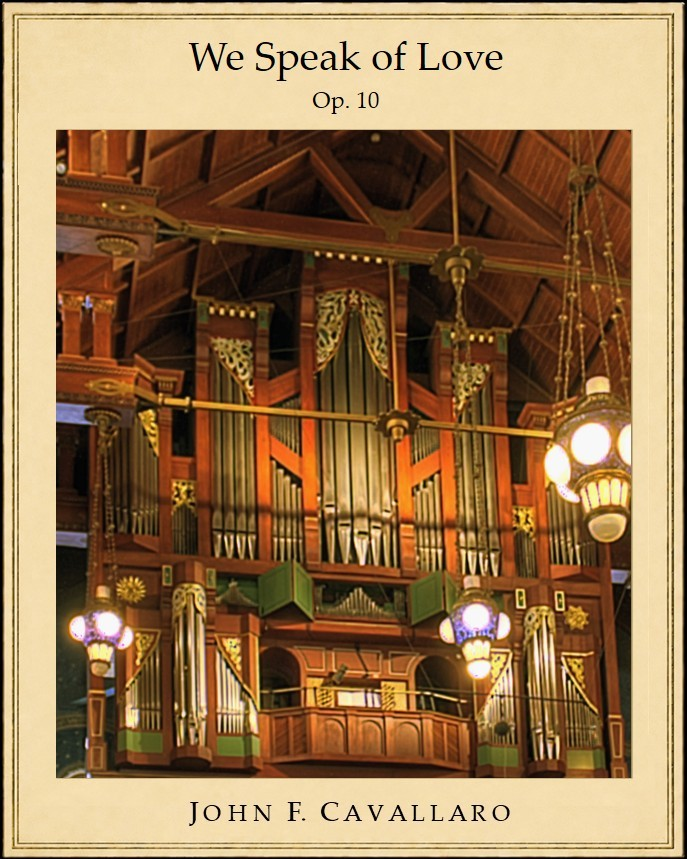
We Speak of Love
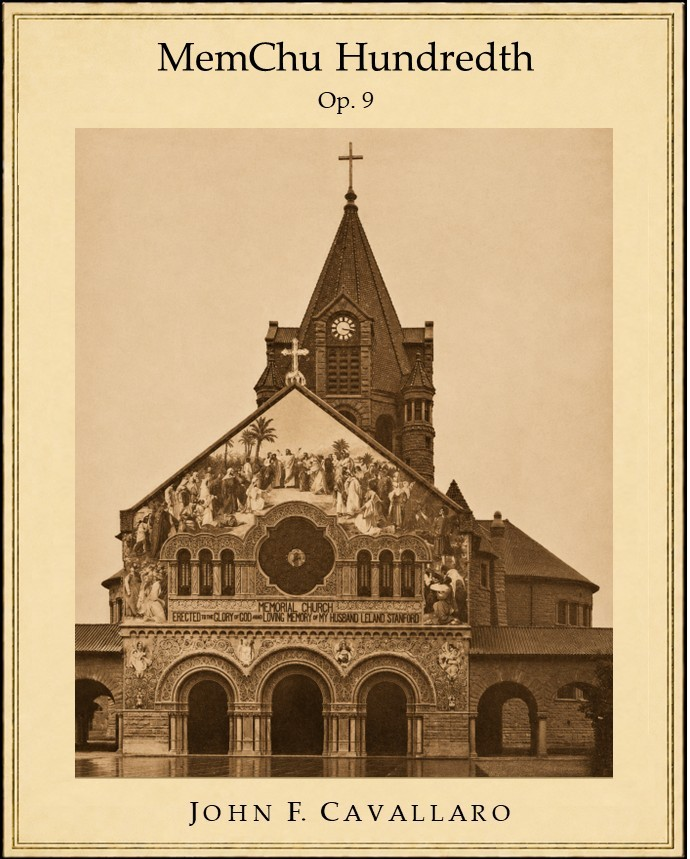
I wrote We Speak of Love for the centennial of Stanford Memorial Church, setting two inscriptions that Jane Stanford had carved into the interior walls. Construction was completed in 1903. The work was performed at the Centennial Concert on November 1, 2003 under the baton of Greg Wait, Music Director of the Memorial Church Choir, and with Robert Huw Morgan, University Organist. It is scored for choir, organ, and a soloist of any voice. Greg Wait, tenor, sang the solo parts at the performance.
The opening is marked andante and stays dreamy and unhurried. Clustered chords hum on the Great while a melody begins to gather, almost reluctantly, in the Pedal. A solo flute stop on the Swell then sings its own line before the soloist enters with the first inscription, which asserts that spiritual love fails to reach full fruition if it is not manifested by our works toward others.
unless we see the power of love manifested;
unless we are given the power to bestow.
The music reaches toward the light at “manifested,” arriving first in C-flat major and then in E-flat major. This small progression (E-flat minor, C-flat major, E-flat major) recurs as the piece unfolds. The soloist carries the thought through “the power to bestow,” growing to fortissimo. The choir then takes up the same idea, sharing the melodic and harmonic ground the soloist laid down, though no single voice holds the original tune completely. The progression at “manifested” returns, extended a little further this time. A similar broadening at “the power to bestow,” now allargando molto, settles deceptively in B-flat major.
The second half opens in E-flat major. A brief organ interlude hints at a new melodic contour without quite committing to it, and the tempo presses ahead, più mosso. The soloist returns to sing the second inscription, which further develops the idea of reaching out to others. The text boldly asserts that all people always hold the potential to becom much more than they currently are, and it is our challenge and mission, in manifesting spiritual love, to be skilled enough to touch that reachable part, thereby releasing its sweet music. The soloist renders the text, now bright and brimming with optimism. The Swell flute offers a lilting countermelody overhead.
some chord that will give forth sweet music
if we only have the skill to touch it.
When the soloist finishes, the chorus responds affirmatively, starting with quiet sustained chords, women first and then men, with different phrases lit up by where each section comes in. A long crescendo at “sweet music” gives way to the same words in four independent lines. Suddenly soft, the organ drops away to leave a cadence on an F-major-seventh chord—that, quite literally, is the sweet music.
From there the music builds to its close: the organ stacks larger and larger chords beneath “if we only have the skill,” the word “skill” returning in eight parts over a long fermata before thinning back to a hush. The final “the skill to touch it” joins soloist and choir together, the Swell flute soaring in on the penultimate sung bar above gentle chords on the Great. At a broad molto rallentando, the Pedal speaks its last word with the 32-foot added, and the piece comes to rest.
The audio sample begins at measure 44, just before the first choir entrance.
Opus 10 | SATB with soloist (any) and organ | English | 8:00
Licensed as a single-use PDF download
Up to 20 copies: $4.50/copy
Unlimited choral license: $90.00
PREVIEW