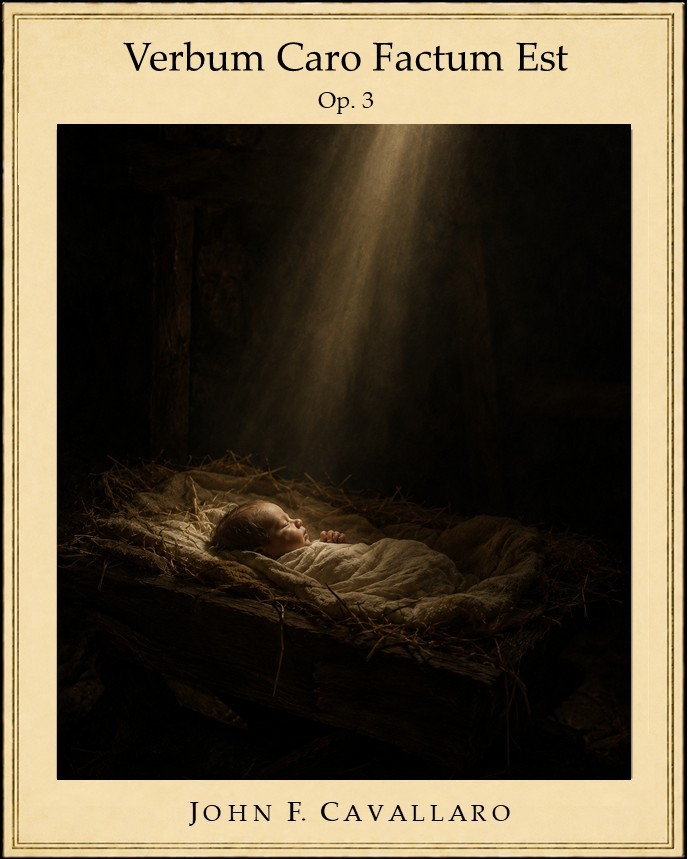
Verbum Caro Factum Est
I set the words of John 1:14, the verse that opens with “The word was made flesh,” for six-part choir (SSATBB) with an optional group of six soloists, who may also be taken by a semi-chorus or small group. I wrote it in 2002, in pencil at the piano, during my Stanford years. I dedicated it to Spencer, a yellow Labrador retriever who kept me company while I composed it.
I built the piece in D minor as a refrain and verses, marked con moto ritmico, rhythmic and propelled. The refrain, Verbum caro factum est, et habitavit in nobis (“The word was made flesh, and dwelled among us”) is first stated in bare unison on an original Gregorian-like theme, then immediately repeated in harmony with the sopranos keeping the melody. Those two statements set the pattern for everything that follows.
The verses pass between groups. The three female soloists take the first verse, introducing dissonances and clusters beyond the plainchant world of the opening. The texture is mostly homophonic but with some words offset for variety. The full choir answers with the refrain, the harmonized repeat now swelling at the cadence to a strong forte rather than tapering down. That forte launches the male soloists, who sing gloriam quasi unigeniti (“a glory as the only-begotten”) similar to the previous trio. An interesting twist is that the phrase a patre (“of the father”) is sung three times, each accented at the front and then falling away to piano.
The refrain returns harmonized anew. The setting of plenum gratiae et veritatis (“full of grace and truth”) builds, recedes and builds again, peaking on gratiae (“grace”) before pressing on through veritatis (“truth”). The six soloists then take the refrain once more, marked poco più animato and turned almost dance-like. The original theme is now hidden inside the harmony. When the full choir enters for the repeat, the music broadens poco a poco into a heavy molto marcato, every syllable weighted and emphasized in turn.
A final et habitavit in nobis (“and dwelled among us”) gathers all the voices. The meter, which has driven in triple time throughout, now opens into common time for a coda marked maestoso e gioioso, though a broad molto rallentando takes hold almost right away. The voices begin forte and soften, and then turn to a new, Neapolitan harmony that leads through a three-bar crescendo. To conclude, the long-minor work bursts at long last into a brilliant D-major chord, fortissimo, under a fermata.
The audio sample begins at measure 39, with the harmonized refrain just before the male soloists enter. Here are the texts in Latin and English:
| Verbum caro factum est, et habitavit in nobis. |
The word was made flesh, and dwelled among us. |
| Et vidimus gloriam eius, gloriam quasi unigeniti a patre, plenum gratiae et veritatis. |
And we have seen his glory, a glory as the only-begotten of the father, full of grace and truth. |
Opus 3 | SATB a cappella | Latin | 3:15
Licensed as a single-use PDF download
Up to 20 copies: $3.50/copy
Unlimited choral license: $70.00