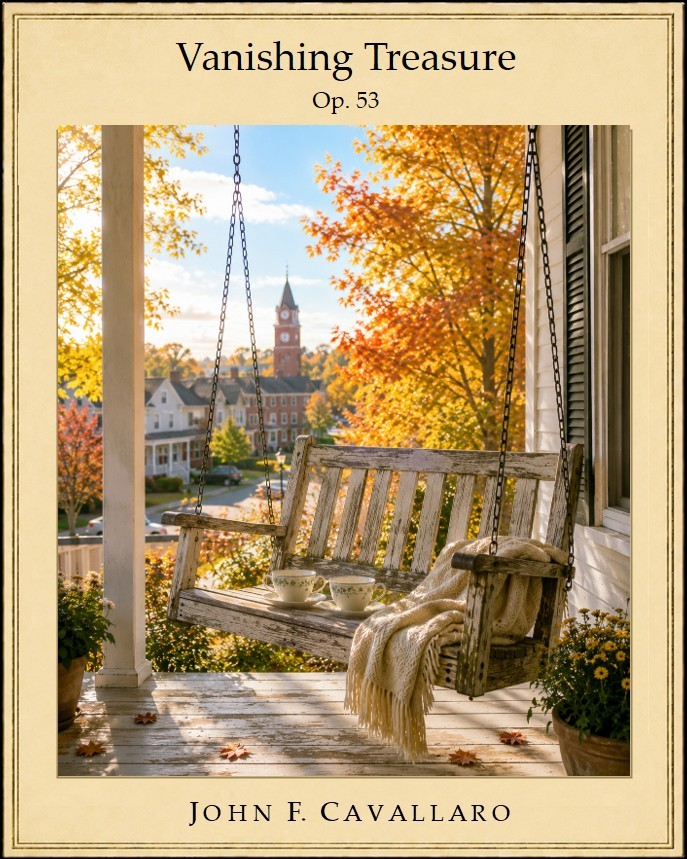
Vanishing Treasure
This commissioned work for SATB chorus and cello was composed for the 25th anniversary of the New World Chorale in Wellesley, Massachusetts, and is dedicated to Holly Krafka, the ensemble’s founder and artistic director. The text is by Emma Tattenbaum-Fine, drawn from her poem Vanishing Treasure, written for the same occasion. The premiere featured the composer’s own cello part played by Holly’s son, Luke Krafka, and marked the second occasion on which this organization has performed my music in concert.
The poem traces a choir’s growth over time, from the hesitancy of new singers to the confident, shared artistry of a seasoned ensemble. The music follows that arc across its three movements. Running throughout the piece is a small four-note “2+5” motive, a tonic and a second answered by a repeated tonic and a fifth, that recurs in changing keys and rhythms, the second sometimes major, sometimes minor, the fifth sometimes perfect, sometimes diminished. It sounds twenty-five times across the work, once for each year being celebrated.
The first movement, marked Andantino cantabile, paints the naïveté of new singers: the poem’s “sour” and “clashing” notes become genuine dissonances, and the “tiptoeing over accidentals” becomes a nervous, wandering figure over cello pizzicato. A canon set against a metronomic col legno battuto tick in the cello lets each vocal section confess, in the first person, “I didn’t always know to count time so preciously.” The first line of the final couplet is introduced by the altos and basses in unison, followed by the second line delivered by the sopranos and tenors in unison. Finally, all voices combine in chorale-like unity, which cadences, deceptively, in E major on “gratefully sung.”
The second movement is a spirited fugue of social vignettes, the singers recalling cackling laughter, camomile tea “on my creaky porch swing” and cabernet “in the kitchen.” Starting a cappella, the sopranos present the subject (which contains the “2+5” motive), and the altos provide the answer. A few sequenced episodes introduce the tenors who present the fugue subject anew, with the basses finally giving their response. After quite a bit of cabernet, the altos introduce a new theme into the mix with “whispered plans” and “inside jokes,” this time with the cello punctuating the laughter. The feeling is that the friendships are deepening as the movement progresses. The theme returns in augmentation on “you remember me when time had no meter” as the fugue reaches for a completion. A short closing section, marked meno mosso and full of dreamy suspensions, illustrates time as “formless and free,” ultimately reaching a brilliant 6-part E-major chord at the cadence.
The final movement brings the return of the “2+5” motive yet again, first introduced by the sopranos and tenors in unison, then answered by the unison altos and basses in response. The singers describe resolution and rest coming “due” but not staying, thus illustrating the fleeting nature of time, and of music itself, which exists only in the moment of hearing. Tellingly, the singular pronoun: “I” has now become the plural “we” as the singers declare “we mark time together” but “we can’t hold it, this vanishing treasure.” The final repeat of the phrase “count time” lands on an extended fortissimo chord of stacked harmonies stretched to the extremes of the range, falling back to piano at “alone.” In a quiet coda to conclude the work, the cello sings the characteristic phrase from the Largo movement of Antonín Dvořák’s “New World” Symphony beneath a softly shimmering chord — a closing nod to the New World Chorale and its twenty-five years.
The choral score includes Emma’s complete poem on the last page; the cello part is a separate downloadable file (included). The first audio clip begins at measure 21 on page 3, at the repeat of “The sourest notes.” The second begins at measure 175 on page 19, at “Rest arrives.” Here are the set stanzas of Emma’s text, by movement, as printed in the score:
The sourest notes love to stick together,
Clashing in our closeness.
Tentative steps we take alone, together.
Tiptoeing over accidentals,
Four staves from the brink,
Calamity collected in a crisp cutoff.
I didn’t always know to count time so preciously.
Time can be dotted, syncopated, or swung,
Well spent, or wasted, or gratefully sung.
II.
I remember us cackling,
Camomile tea on my creaky porch swing,
Cabernet in the kitchen,
Whispered plans, inside jokes,
Which I cannot recount in present company.
You remember me when
Time had no meter,
Time was formless and free.
III.
Suspension begs a question,
Fermatas keep change at bay,
Resolution comes due,
Rest arrives, but won’t stay,
So time takes shape in its signature way.
We mark time together,
respectful of its measure,
Knowing we can’t hold it,
this vanishing treasure.
We didn’t always know to count time so preciously,
But we knew we wouldn’t count time alone.
Text © Emma Tattenbaum-Fine, all rights reserved.
Opus 53 | SATB with cello obbligato | English | 12:30
Licensed as a single-use PDF download
Up to 20 copies: $5.50/copy
Unlimited choral license: $110.00
PREVIEW
Customers Also Bought
Related products
-
Add to WishlistAdd to Wishlist
Great Little One
$3.50 – $70.00Price range: $3.50 through $70.00 Select options This product has multiple variants. The options may be chosen on the product page -
Add to WishlistAdd to Wishlist
Ave Maria
$3.50 – $70.00Price range: $3.50 through $70.00 Select options This product has multiple variants. The options may be chosen on the product page -
Add to WishlistAdd to Wishlist
Levate in Excelsum
$3.50 – $70.00Price range: $3.50 through $70.00 Select options This product has multiple variants. The options may be chosen on the product page -
Add to WishlistAdd to Wishlist
Missa Brevis Orbis Factor
$4.50 – $90.00Price range: $4.50 through $90.00 Select options This product has multiple variants. The options may be chosen on the product page